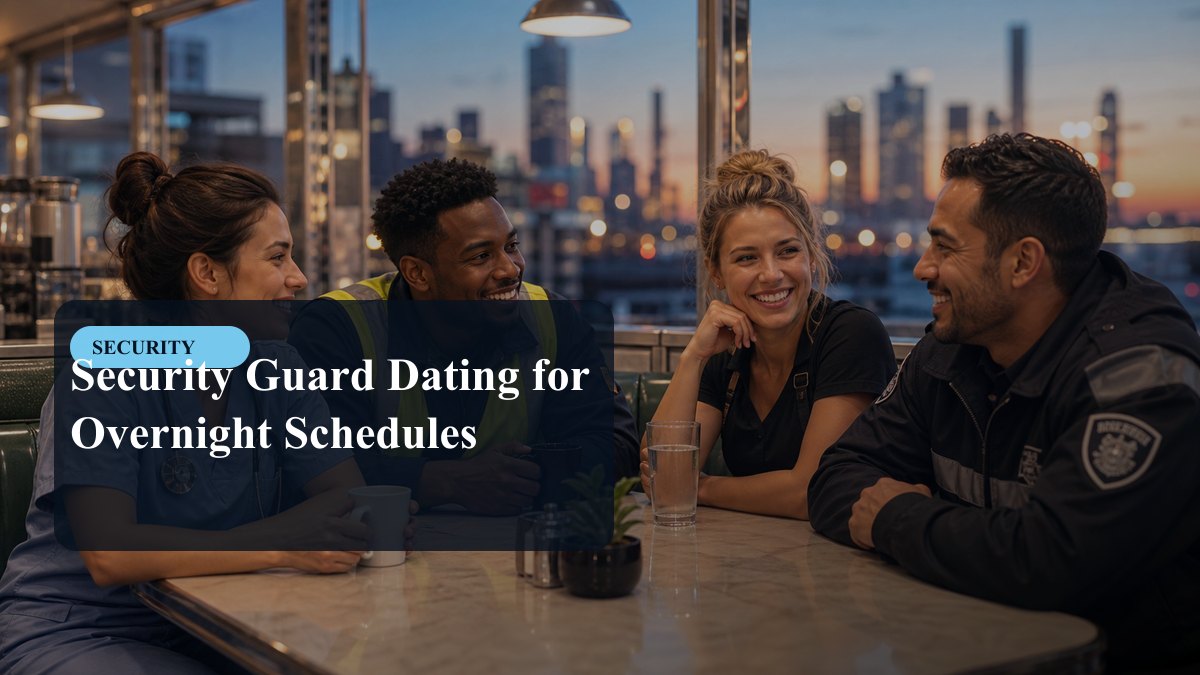
It is 3:12 a.m., the tour is finished, the daily activity report is written up to the hour, and the next checkpoint is forty minutes away. That gap is the odd advantage of overnight security work. Most jobs make dating harder by eating your attention; a quiet static post does the opposite, handing you long stretches in which you are awake, alone, and genuinely able to hold a conversation. Whether you can use them depends entirely on the post you are standing.
The post decides more than the shift does
Two guards can both work 2300 to 0700 and live completely different social lives, because the assignment governs what your hands and eyes are doing all night.
| Assignment | Phone reality | Usable conversation windows |
|---|---|---|
| Static lobby or concierge desk | Often tolerated at the desk, camera pointed at you | Long, once foot traffic dies after midnight |
| CCTV console or monitor room | Usually restricted, eyes on screens | Short and unreliable |
| Roving patrol, campus or warehouse | Between tours only | Fifteen to thirty minute bursts |
| Mobile patrol across several sites | Driving, so effectively none | Break periods only |
| Construction gatehouse or remote yard | Generally permitted | Very long, very quiet |
| Hospital ED or venue post | None while anything is happening | Unpredictable by design |
The caution matters as much as the opportunity. Plenty of contracts prohibit personal phone use outright, the desk camera records you, and supervisors run spot checks between one and four in the morning precisely because that is when attention drops. No conversation is worth a write-up or a lost post. If the site rules say phone in the locker, your dating life adjusts around breaks instead.
Check-ins chop the night into chapters
Even on a permissive site, the night is not one continuous block. Guard tour systems make sure of it: NFC or iButton checkpoints scanned on a set route, hourly log entries, radio or app check-ins with a dispatcher, and lone-worker timers that escalate to a supervisor if you fail to acknowledge. On many contracts a missed check-in triggers a call to your phone within minutes and a car to the site shortly after.
The practical effect is that you disappear on a schedule. Tell whoever you are talking to what that schedule is. "I go dark for about fifteen minutes on the hour, that is a walk round the building, not me losing interest" prevents an enormous amount of imagined rejection. It also demonstrates that you are dependable to a timetable, which is not the worst first impression to make.
The overtime math nobody puts in a profile
Contract security pay often sits near the local floor, and the standard response is hours. Guards run 16-hour doubles, hold a second site on their days off, stack four-on four-off 12s against a weekend gig, and clear 60 to 72 hours in a bad month. Then there is mandatory holdover: your relief no-shows at 0700, you cannot leave the post unmanned, and you are still there at 0900 with no warning and no say in it.
This is the real reason security dating collapses, and it is not mysterious. Somebody promised Thursday, got held over Wednesday night, slept through Thursday afternoon and cancelled at five. The fix is to stop promising what the roster can revoke. Offer the day after a scheduled day off rather than the morning after a shift. Say early that holdover happens and that you will send a message the moment it does. And when you are taking doubles to cover a bill, name it as a stretch with an end date instead of letting someone slowly conclude you are unavailable forever.
What not to put in a profile
Security is one of the few jobs where oversharing about work is an operational problem rather than just a bore. "I am the only guard at such-and-such building from eleven to seven" tells a stranger the coverage gap at a site you are paid to protect. Keep it at sector level.
- No site names, addresses, client logos, or shots of a badge or licence number
- No photos in uniform on a recognisable post, and no location tags on anything taken at work
- Nothing about patrol timings, gate codes, alarm response times, or which cameras are down
- Check your employer's social media policy before posting anything from the job at all
What is fine to say: that you work overnight security, whether you are static or roving, what your days off look like, and that you are licensed. In the UK that means an SIA licence; in much of the United States it is a state guard card, such as a BSIS card in California or a Class D licence in Florida. Mentioning it is not showing off, it explains that this is a regulated job you intend to keep.
Using the 3 a.m. hours well
A quiet post produces a specific kind of conversation that daytime workers rarely get. You can write four paragraphs instead of a thumbs-up, record a low-volume voice note, read the same article and actually discuss it. You are also awake at the same hour as a large population of other night workers: ED nurses, 911 dispatchers, bakers, freight handlers on the second sort, and support agents in Manila or Cebu whose working day sits neatly on top of your night.
One warning about those hours. Six nights of five-hour conversations manufacture a closeness that has not been tested by daylight, and people regularly mistake volume for compatibility, then feel oddly flat when they finally meet. Pace it deliberately. Move to a short call in the first week, meet in person before the messaging becomes a substitute for meeting, and keep the marathon threads for after you know who you are talking to.
Meeting when your weekend lands on a Tuesday
On a four-on, four-off rotation your free days walk through the calendar, so stop chasing Saturdays and use the middle two days of your break, when you have slept twice and are neither wrecked from the last shift nor bracing for the next one. Breakfast at eight after a Friday night is fine for a short first meeting, but be honest that you have been vertical for thirteen hours and your feet know it; a nine o'clock hike after a 12 is a plan you will regret at the trailhead. Late afternoon before a 2200 start works well, with two rules: no drinking before a shift, and leave a real buffer, because turning up to a post short on sleep is a safety issue rather than just a tired one.
It is also worth correcting the "you just sit there" assumption early, without turning it into a war story. Overnight guards handle intrusions, medical emergencies and aggressive people, alone, with a radio as the only backup. Someone who grasps that will also grasp why you sometimes finish a shift wired at seven in the morning.